Regional Business Flying
Save time on short regional legs compared to turboprops.
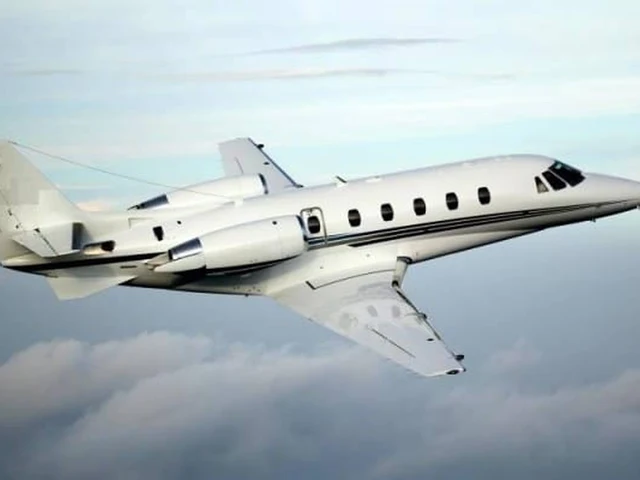

Capacity
up to 8 pax
Speed
772 km/h
Range
3,236 km
Cabin height
1.46 m
Cabin length
5.27 m
Cabin width
1.49 m
Luggage
Baggage
Estimated rental price
6,650 € / hour
7,867 $ / hour
Find your scenario
Save time on short regional legs compared to turboprops.
Frequent climbs and descents with short turn times.
Ideal for shorter runways where light jets excel.
Perfect for 4–6 passengers with baggage.
Measurement system:
Range
3,236 km
Cruise Speed
772 km/h
Service Ceiling
13,715 m
Takeoff weight
7,212 kg
Number of Engines
2
Engine Model
Pratt & Whitney Canada JT15D5A
Landing Distance
679 m
Takeoff Distance
963 m
Start of Production
1989 y
End of Production
1994 y

Rent price
All prices are estimates. Final costs are subject to real-time aircraft availability and individual mission details. Contact your JETVIP expert for a firm quote and the most competitive market rate for your trip.
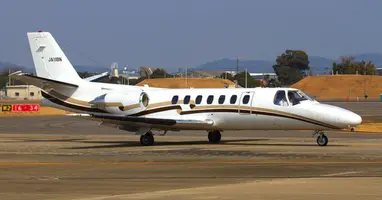
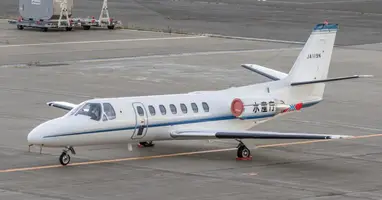
The Cessna Citation V (Model 560) is a well-regarded light business jet that strikes a balance between cabin comfort, performance, and operational efficiency. Introduced in 1989, it became a popular choice for individuals, businesses, and charter operators due to its reliability and versatility.
Key Features:
Technical Data:
Citation V with JETVIP:
The Cessna Citation V can be a suitable option for JETVIP clients for both charter and acquisition, particularly those seeking a reliable and comfortable light jet for regional travel.
Contact JETVIP today to discuss your charter or acquisition needs for the Cessna Citation V. Our experienced team can provide detailed information on available aircraft and assist you in finding the best solution for your travel requirements from our Vienna, Austria location.
Regional business flying (roughly 300–1,200 nm legs) with time savings over turboprops
Multi-leg days with frequent climbs/descents and short turn times
Accessing shorter runways and smaller airports where light-jet performance is advantageous
The Cessna Citation V (Model 560) is a light jet positioned between early Citation II variants and later “Encore” evolutions, offering higher cruise performance and improved climb compared with earlier straight-wing Citations while retaining practical runway capability. It is commonly used for regional business missions, multi-stop days, and access to smaller airports where larger cabin jets may be less flexible. Buyers typically evaluate it as a proven, widely supported platform with straightforward systems and a cabin sized for small teams.
In typical operation the Citation V is well matched to owner-operators and corporate flight departments needing efficient point-to-point travel for 4–6 passengers plus baggage, often with one fuel stop for longer trips. It performs best when planned around light-jet payload/range tradeoffs—more passengers, bags, or adverse winds will reduce range or require a stop.
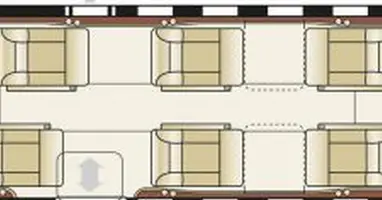
The cabin is configured as a light-jet executive interior, usually with a center aisle and club seating. For its class, the Citation V offers a usable work-and-conversation environment, though it remains a compact cabin with limited stand-up space and modest aft baggage compared with larger jets. Noise levels and ride quality are typical of legacy light jets; passenger comfort is strongest on regional stages rather than very long sectors.
Citation V avionics and cockpit equipment vary widely by serial number and retrofit history. Many aircraft have transitioned from analog/early EFIS suites to modern glass retrofits, while others retain more traditional instrumentation. The platform’s systems are generally conventional for the era, emphasizing proven hydraulics/electrics and straightforward pressurization/environmental control rather than highly integrated, software-driven architectures.
Operators typically value the Citation V for its combination of cruise speed, climb, and practical field performance in the light-jet segment. Mission planning should account for payload and fuel tradeoffs, particularly when targeting longer legs, high/hot conditions, or short runways. Crew workload and training needs depend heavily on avionics configuration; modernized panels can reduce workload, while legacy equipment may be more demanding in busy terminal environments.
Number of aircraft of this model at each base.

Built / int. refit
1995 / 2022
Capacity
up to 7 pax
Baggage
Cabin height
1.46 m
Rental price
6,650 € / hour7,867 $ / hour
Estimated cost
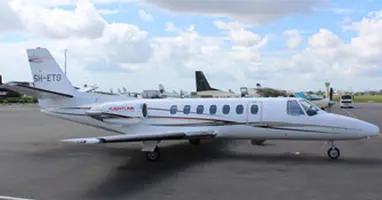
Built / int. refit
1990
Baggage
Cabin height
1.46 m
Rental price
4,000 € / hour4,720 $ / hour
Estimated cost
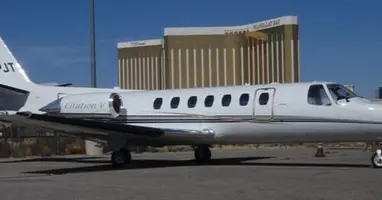
Built / int. refit
1990
Capacity
up to 7 pax
Baggage
Cabin height
1.46 m
Rental price
4,000 € / hour4,720 $ / hour
Estimated cost
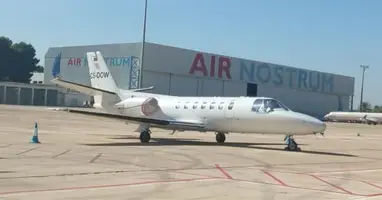
Built / int. refit
1990 / 2021
Capacity
up to 8 pax
Baggage
Cabin height
1.46 m
Rental price
6,650 € / hour7,867 $ / hour
Estimated cost
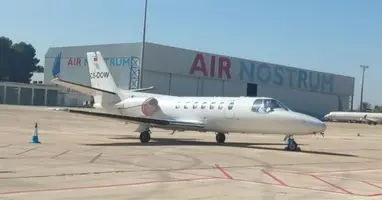
Built / int. refit
1990 / 2021
Capacity
up to 8 pax
Baggage
Cabin height
1.46 m
Rental price
6,650 € / hour7,867 $ / hour
Estimated cost
Built / int. refit
2009
Baggage
Cabin height
1.46 m
Rental price
4,000 € / hour4,720 $ / hour
Estimated cost
Built / int. refit
2011
Capacity
up to 6 pax
Baggage
Cabin height
1.46 m
Rental price
4,000 € / hour4,720 $ / hour
Estimated cost
Built / int. refit
1997
Capacity
up to 6 pax
Baggage
Cabin height
1.46 m
Rental price
4,000 € / hour4,720 $ / hour
Estimated cost