Regional Business Travel
Efficient travel for 4–8 passengers with minimal baggage.
Year built (YOM)
1982
Passengers
9 seats
Serial number (MSN)
378
Previous registration
C-GXKF
Registration country
United States of America
Estimated rental price
1,500 € / hour
1,770 $ / hour
Find your scenario
Efficient travel for 4–8 passengers with minimal baggage.
Ideal for remote area flights with proper equipment.
Focus on speed and runway flexibility over amenities.
Measurement system:
Range
2,555 km
Cruise Speed
741 km/h
Service Ceiling
6,100 m
Takeoff weight
10,660 kg
Landing Distance
655 m
Takeoff Distance
1561 m
Passenger Capacity
up to 8 pax
Cabin Length
4 m
Cabin Width
1 m
Cabin Height
1 m
Cabin Volume
6 cub.m
Standard seating
8 pax
Aircraft Length
15.93 m
Aircraft Height
4.81 m
Wingspan
13.65 m

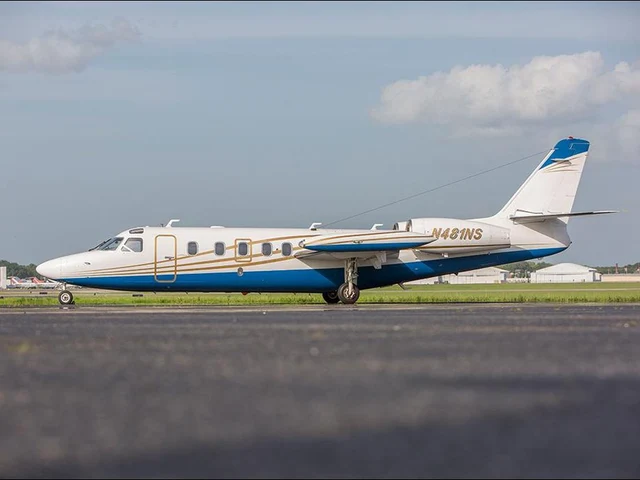
Westwind I with tail number N481NS (serial number 378) belongs to the Turbo Prop class and is aviacompany. The aircraft is based at (MQY, United States) and is available for commercial charter.
The registration prefix N indicates that the aircraft is registered in United States of America. The first letters of any tail number correspond to the country’s aviation registry.
Charter availability for this aircraft is provided by the operator. However, clients can book this jet directly through JETVIP — a professional international charter brokerage platform. We negotiate with operators, secure the best available terms, track real-time availability and ensure competitive and transparent pricing for our clients.
The Westwind I holds a popularity rating of 2.9 out of 5 , reflecting strong demand and operational stability in the charter market.
The aircraft was manufactured in 1982. Previously, the aircraft operated under registration ex C-GXKF.
Westwind I N481NS accommodates up to 9 passengers. . The maximum flight range reaches 2555 km, depending on payload and weather conditions.
To check the availability and charter rates of N481NS, contact JETVIP — we will provide the best offer tailored to your trip.
Regional business travel with 4–8 passengers and limited baggage complexity
Long overwater/remote-area legs when equipped and operated with appropriate approvals and equipment
Operators prioritizing cruise speed and runway flexibility over newest-cabin amenities
The IAI Westwind 2 is a legacy midsize business jet derived from the Westwind airframe family, known for higher-speed cruise compared with many contemporaries of its era and for operating from a wide range of paved airports. It typically appeals to buyers who want a capable point-to-point aircraft for regional-to-long regional missions and who are comfortable with older-generation avionics and cabin systems, or who plan targeted modernization.
In typical operations, the Westwind 2 is used for owner and corporate travel where time en route matters and cabin expectations are ‘traditional business jet’ rather than large-cabin. It can cover many domestic and near-international city pairs efficiently, but mission planning should account for payload/range tradeoffs, alternate and reserve requirements, and the specific aircraft’s avionics and equipment list.
Cabin experience is defined by a classic midsize-jet cross-section with club-style seating common, practical aisle access, and a layout optimized for business travel rather than open, lounge-like space. Noise levels, pressurization feel, and environmental controls depend heavily on aircraft condition and interior refurbishment history; many examples have been updated with modern materials and selective comfort upgrades.
The Westwind 2 reflects an earlier avionics philosophy: reliable core systems with fewer integrated automation features than modern glass-cockpit jets. Many aircraft have received avionics retrofits (e.g., GPS/FMS, digital autopilot upgrades, ADS-B solutions), and the buyer experience is shaped more by the specific upgrade pathway than by the baseline type design.
Operationally, the Westwind 2 tends to reward buyers who fly predictable trip lengths and can plan around legacy-platform realities: higher crew workload than newer designs, more variability between individual aircraft, and performance that is sensitive to weight, temperature, and runway length. Budgeting and scheduling should assume that aircraft condition and maintenance program choices drive real-world availability as much as the published performance envelope.
Rent price
The cost is calculated for a one-way flight for 3 passengers based on historical data for this type of aircraft. The final price will be offered by the manager.