Regional Business Travel
Frequent legs in the 200–700 nm range for efficiency.

Year built (YOM)
1987
Serial number (MSN)
FA-115
Luggage
Baggage
Registration country
United States of America
Estimated rental price
5,200 € / hour
6,162 $ / hour
Find your scenario
Frequent legs in the 200–700 nm range for efficiency.
Access to smaller airports where jets may struggle.
Versatile configurations for varied mission needs.
Ideal for medical, survey, or government tasks.
Measurement system:
Range
2,450 km
Cruise Speed
490 km/h
Service Ceiling
7,570 m
Takeoff weight
6,350 kg
Number of Engines
2
Engine Model
PT6A-60A
Fuel consumption
2,044 L/h
Landing Distance
755 m
Takeoff Distance
1203 m

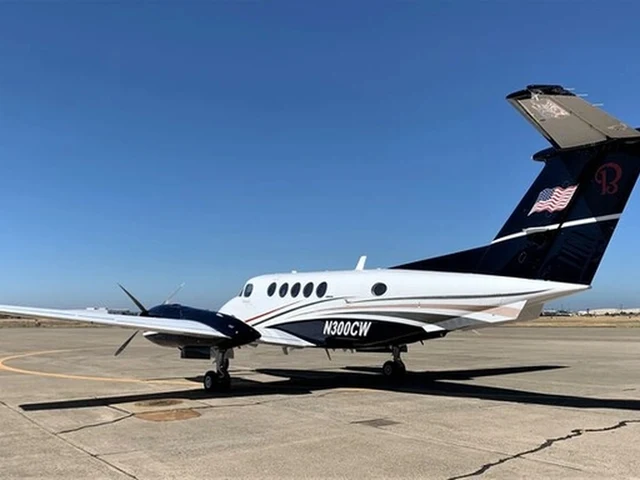
King Air 300 with tail number N300CW (serial number FA-115) belongs to the Turbo Prop class and is Sacramento Air Charter. The aircraft is based at (MCC, United States) and is available for commercial charter.
The registration prefix N indicates that the aircraft is registered in United States of America. The first letters of any tail number correspond to the country’s aviation registry.
Charter availability for this aircraft is provided by Sacramento Air Charter. However, clients can book this jet directly through JETVIP — a professional international charter brokerage platform. We negotiate with operators, secure the best available terms, track real-time availability and ensure competitive and transparent pricing for our clients.
The King Air 300 holds a popularity rating of 3.8 out of 5 and a reliability rating of 83.0 out of 100 according to the JETVIP Reliability Index , reflecting strong demand and operational stability in the charter market.
King Air 300 N300CW . The baggage compartment volume of 16.4 m³ can hold up to 49 large suitcases . The maximum flight range reaches 2450 km, depending on payload and weather conditions.
The aircraft is powered by 2PT6A-60A engines with an average fuel burn of 540 gallons per hour , ensuring efficiency and reliability on long-distance routes.
To check the availability and charter rates of N300CW, contact JETVIP — we will provide the best offer tailored to your trip.
Regional business travel with frequent legs in the 200–700 nm range
Operations into shorter runways and smaller airports where jet access may be limited
Mixed passenger/cargo or special-mission roles (e.g., medical, survey, government) depending on interior and equipment
The Beechcraft King Air 300 series (commonly referring to the King Air 350/350i family in many listings) is a pressurized, twin‑engine turboprop built around reliable regional performance, a stand-up style cabin for its class, and strong access to shorter and more constrained runways compared with many jets. It is typically selected for owners and operators who prioritize dispatch reliability, mixed-use utility, and the ability to operate into smaller airports while carrying a practical passenger load.
This model is generally used for multi-stop regional days where airport access and schedule resilience matter. Its strengths show up when the mission includes shorter runways, variable weather, and a need to carry people plus bags without depending on major hubs. If most trips are long, nonstop city pairs where cruise speed dominates total trip time, a light or midsize jet may fit better.
The King Air 300-class cabin is designed around practical comfort: pressurization for typical turboprop cruise altitudes, club-style seating in many configurations, and good baggage flexibility for its size. Cabin noise and vibration are generally higher than in comparable business jets, though later interior packages and operator-installed sound treatments can improve perceived comfort. Entry is via an airstair door, and many aircraft are configured to support easy loading for business, family, or mission equipment.
Avionics and systems are oriented toward dependable IFR utility and crew workload management rather than cutting-edge automation. Many aircraft have been upgraded with modern flight decks (e.g., Garmin or Collins suites) and connectivity options, but the fleet is mixed—capability is determined more by individual aircraft equipment lists than by the model name alone.
Typical operations emphasize flexibility: shorter field access, efficient mid-altitude cruise, and the ability to carry useful loads without jet-level infrastructure requirements. Real-world cruise speed, range, and payload are highly sensitive to model variant, engine rating, propeller configuration, installed options, and whether the aircraft is operated at high weights or in hot/high environments.
Rent price
The cost is calculated for a one-way flight for 3 passengers based on historical data for this type of aircraft. The final price will be offered by the manager.