Regional Business Travel
Frequent legs in the 200–700 nm range for efficiency.
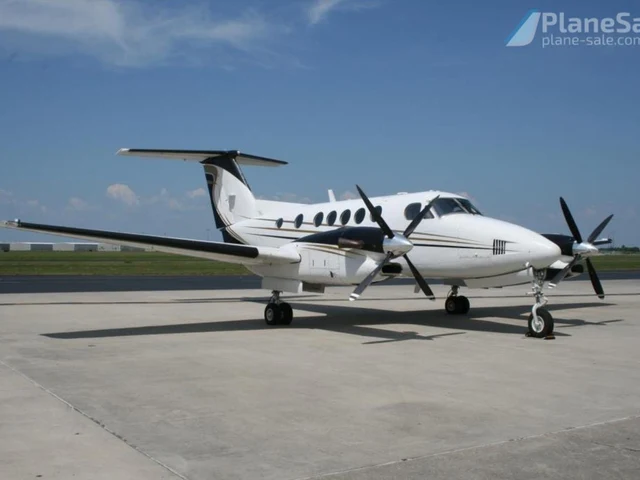

Capacity
up to 6 pax
Speed
490 km/h
Range
2,450 km
Cabin height
1.25 m
Cabin length
5.1 m
Cabin width
1.4 m
Luggage
Baggage
Estimated rental price
5,200 € / hour
6,162 $ / hour
Find your scenario
Frequent legs in the 200–700 nm range for efficiency.
Access to smaller airports where jets may struggle.
Versatile configurations for varied mission needs.
Ideal for medical, survey, or government tasks.
Measurement system:
Range
2,450 km
Cruise Speed
490 km/h
Service Ceiling
7,570 m
Takeoff weight
6,350 kg
Number of Engines
2
Engine Model
PT6A-60A
Fuel consumption
2,044 L/h
Landing Distance
755 m
Takeoff Distance
1203 m
Start of Production
1984 y
End of Production
1994 y
Mid-Life Cost
0 $

Rent price
All prices are estimates. Final costs are subject to real-time aircraft availability and individual mission details. Contact your JETVIP expert for a firm quote and the most competitive market rate for your trip.
The Beechcraft King Air 300 stands as a testament to advanced turboprop engineering, offering an exceptional blend of efficiency, comfort, and operational flexibility. This iconic aircraft continues to be a preferred choice for executives, charter operators, and organizations requiring dependable regional air transportation.
The King Air 300 offers distinct advantages over its competitors in the turboprop and light jet markets. While the Pilatus PC-12 provides single-engine economy, the King Air 300's twin-engine configuration delivers superior safety redundancy. Compared to the Cessna Citation CJ1, the King Air 300 consumes approximately 30% less fuel while offering similar cabin space and only marginally longer flight times on trips under 500 miles.
Unlike jet alternatives, the King Air 300 excels in challenging airport conditions with its ability to operate from short runways (under 3,500 feet) and unpaved airstrips, providing access to over 5,000 airports worldwide compared to roughly 500 airports accessible by typical light jets.
The King Air 300's cabin is thoughtfully designed for passenger comfort during regional travel:
JETVIP offers exceptional King Air 300 charter services with numerous benefits:
"JETVIP's King Air 300 has become our company's go-to solution for visiting multiple regional manufacturing facilities in a single day. The aircraft's ability to land at smaller airports puts us exactly where we need to be, saving valuable time and eliminating exhausting road transfers." — Michael T., Operations Director at a manufacturing company
"We chartered the King Air 300 for our executive team's quarterly site visits. The cabin provided the perfect environment for pre-meeting strategy discussions, and the aircraft's reliability meant we never missed a connection. JETVIP's service was impeccable from booking to landing." — Sarah J., Executive Assistant to CEO
"As a medical consultant serving multiple rural hospitals, the King Air 300 from JETVIP has revolutionized my practice. I can now visit three facilities in different states in a single day and return home for dinner with my family. The value proposition is undeniable." — Dr. Robert K., Healthcare Consultant
The King Air 300's versatility makes it particularly well-suited for:
Discover the perfect balance of efficiency, comfort, and cost-effectiveness with JETVIP's King Air 300 charter services. Our aviation consultants are ready to design a customized travel solution that maximizes your productivity and minimizes travel time.
Choose the aircraft that business professionals trust for regional travel – the King Air 300 with JETVIP's renowned service excellence backing every flight.
Regional business travel with frequent legs in the 200–700 nm range
Operations into shorter runways and smaller airports where jet access may be limited
Mixed passenger/cargo or special-mission roles (e.g., medical, survey, government) depending on interior and equipment
The Beechcraft King Air 300 series (commonly referring to the King Air 350/350i family in many listings) is a pressurized, twin‑engine turboprop built around reliable regional performance, a stand-up style cabin for its class, and strong access to shorter and more constrained runways compared with many jets. It is typically selected for owners and operators who prioritize dispatch reliability, mixed-use utility, and the ability to operate into smaller airports while carrying a practical passenger load.
This model is generally used for multi-stop regional days where airport access and schedule resilience matter. Its strengths show up when the mission includes shorter runways, variable weather, and a need to carry people plus bags without depending on major hubs. If most trips are long, nonstop city pairs where cruise speed dominates total trip time, a light or midsize jet may fit better.
The King Air 300-class cabin is designed around practical comfort: pressurization for typical turboprop cruise altitudes, club-style seating in many configurations, and good baggage flexibility for its size. Cabin noise and vibration are generally higher than in comparable business jets, though later interior packages and operator-installed sound treatments can improve perceived comfort. Entry is via an airstair door, and many aircraft are configured to support easy loading for business, family, or mission equipment.
Avionics and systems are oriented toward dependable IFR utility and crew workload management rather than cutting-edge automation. Many aircraft have been upgraded with modern flight decks (e.g., Garmin or Collins suites) and connectivity options, but the fleet is mixed—capability is determined more by individual aircraft equipment lists than by the model name alone.
Typical operations emphasize flexibility: shorter field access, efficient mid-altitude cruise, and the ability to carry useful loads without jet-level infrastructure requirements. Real-world cruise speed, range, and payload are highly sensitive to model variant, engine rating, propeller configuration, installed options, and whether the aircraft is operated at high weights or in hot/high environments.
Number of aircraft of this model at each base.

Built / int. refit
1989
Capacity
up to 7 pax
Baggage
Cabin height
1.25 m
Rental price
2,000 € / hour2,360 $ / hour
Estimated cost
Built / int. refit
2003
Baggage
Cabin height
1.25 m
Rental price
5,200 € / hour6,162 $ / hour
Estimated cost
Built / int. refit
2000
Capacity
up to 8 pax
Baggage
Cabin height
1.25 m
Rental price
2,000 € / hour2,360 $ / hour
Estimated cost
Built / int. refit
2007
Baggage
Cabin height
1.25 m
Rental price
5,200 € / hour6,162 $ / hour
Estimated cost
Built / int. refit
1995
Capacity
up to 7 pax
Baggage
Cabin height
1.25 m
Rental price
2,000 € / hour2,360 $ / hour
Estimated cost
Built / int. refit
1991
Baggage
Cabin height
1.25 m
Rental price
5,200 € / hour6,162 $ / hour
Estimated cost
Built / int. refit
2007
Baggage
Cabin height
1.25 m
Rental price
5,200 € / hour6,162 $ / hour
Estimated cost
Built / int. refit
1990
Baggage
Cabin height
1.25 m
Rental price
5,200 € / hour6,162 $ / hour
Estimated cost