Private Jet Cabin Technology - Everything You Need to Know
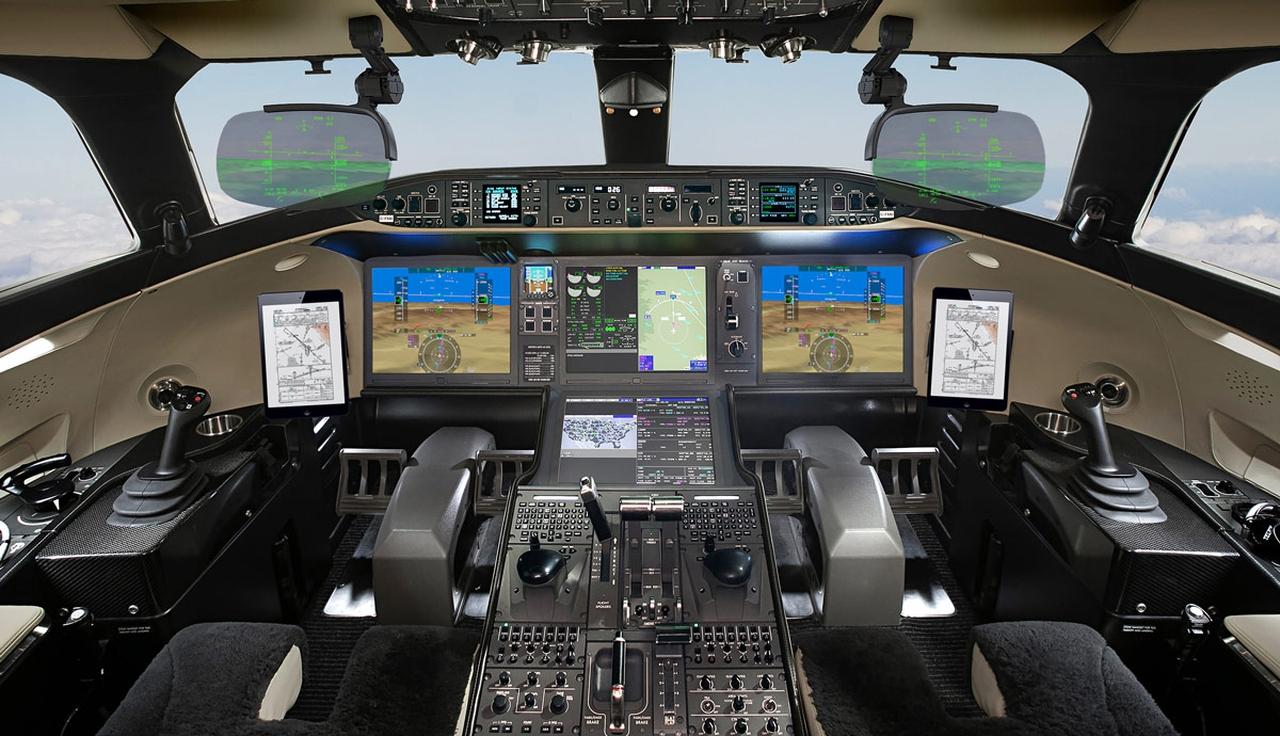
The crew cabin technology is a critically important aspect of a private jet that is often overlooked.
The more advanced and reliable the technology, the safer the flight. Cutting-edge technologies provide pilots with more information while reducing overall workload. As a result, pilots can manage information better and stay more focused in the cockpit. All of this makes flying safer.
Moreover, the more developed the technologies, such as flight control systems and autopilot technology, the smoother the flight will be. Consequently, passengers in the cabin will experience greater comfort.
However, passengers and clients often do not pay attention to this technology.
In the early days of powered flight, pilots relied on their surroundings for most of their information.
However, this changed soon after, when computers became small enough to be used in aircraft during the latter half of the 20th century.
Until the 1970s, aircraft cockpits were cluttered with indicators, instruments, and electromechanical controls.
Complex dials on controllers were designed for a three-person crew, consisting of two pilots and one engineer. A typical aircraft of that time had over 100 instruments and controls, each with its own set of dials, needles, and symbols. All these displays required a lot of space and full attention from the pilots.
The development of display devices capable of converting flight data and raw information provided by aircraft systems into easy-to-understand images was the result of research aimed at finding a solution to this problem.
This evolution was made possible only by fundamental changes in the way onboard systems process information. Earlier tools, based on analog information, provided readings that were directly related to physical phenomena, such as air pressure, flight speed, or gyroscope position.
The digitization of physical data necessary for flight control and navigation has led to a significant transformation of the aircraft cockpit. Data can be easily converted from analog to digital format, processed by computers, and displayed on screens in the crew cabin thanks to advancements in electronics and computer technology.
Fly-By-Wire Technology
The technology of fly-by-wire was first operationally introduced by NASA in the 1970s, initially applied in fighter aviation. This was a direct byproduct of the space program, which was used to maneuver the Apollo lunar module.
By implementing digital remote control technology in civil aircraft, the Airbus A320 revolutionized commercial aviation. It set new standards for safety and efficiency. Since its market introduction in 1988, every new airliner has been equipped with telecommunication technology.
However, the technology of fly-by-wire has not been adopted as quickly in business jets.
Advantages of Fly-by-Wire Technology
- Flight-Envelope Protection software aids in automatic stabilization of the aircraft and prevents unsafe actions.
- Reduced fatigue and increased passenger comfort by mitigating turbulence.
- Optimized trim settings reduce drag.
- Autopilot and other automated flight control systems are easier to operate.
- Lower maintenance costs.
- Reduced pilot training costs for airlines (flight management becomes very similar across the aircraft family). Pilot workload can be reduced.
- Fly-by-wire flight control systems also improve flight efficiency, eliminating the need for many mechanical and heavy flight control mechanisms and cables, aside from hydraulic systems, which take up less space, are less complex, and more reliable.
"Glass Cockpit"
A "glass cockpit" is one where flight, engine, and aircraft data are displayed on electronic screens instead of separate instruments for each gauge.
A set of six computer monitors can replace hundreds of switches and sensors, reducing the burden on the flight crew.
One of the key advantages of a "glass cockpit" is that values are easier to read. The data is much clearer than a needle, yet provides accurate numbers.
This allows pilots to determine their speed, altitude, and position more quickly.
The second advantage of a "glass cockpit" is space. One display can show potentially hundreds of parameters while taking up less space than if each metric had its own indicator.
In many cases, there are parameters that need to be checked infrequently. Consequently, these parameters can be placed in a menu instead of having a constant display that is rarely used.
Furthermore, the glass cockpit allows for better data visualization. For example, glass displays provide better weather and terrain information.
Although electronic flight indicators are considered more reliable than analog ones due to the absence of moving parts, they are vulnerable to electrical system failures and software glitches. Therefore, some devices have analog displays on standby in case of electronic display failures.
ADS-B Signal Monitoring
ADS-B is a system in which electronic equipment on board the aircraft transmits the precise location of the aircraft. This is achieved through a digital data transmission channel. This data can be used by other aircraft and air traffic control to view the aircraft's position and altitude on display screens without the need for radar.
An aircraft equipped with ADS-B uses GPS to determine its location. The transmitter then sends this position along with identity, altitude, speed, and other data at regular intervals. Radio transmissions are received by ADS-B ground stations, which then send the information to air traffic control for accurate tracking of aircraft.
The abbreviation "ADS-B" stands for:
Automatic – requires no pilot intervention or external request
Dependant – relies on precise position and speed data from the aircraft's navigation system (e.g., GPS)
Surveillance – provides the aircraft's position, altitude, speed, and other observational data to services that require this information
Broadcast – information is transmitted for use by both aircraft and ground services
CPDLC Communication System
Controller-Pilot Data Link Communications (CPDLC) allows controllers to send messages to the aircraft instead of using voice communication. The message is displayed on a visual display in the crew cabin.
For air traffic services, the CPDLC application provides "air-ground" data transmission. It supports several data link services (DLS) that allow the exchange of communication management messages and permissions/information/requests that are voice phraseology compatible with air traffic control procedures.
Controllers are given the ability to issue air traffic control clearances, frequency assignments, and various information requests.
Pilots are given the ability to respond to messages, request/receive permissions.
As a result, reading errors of pilot data are no longer an issue for this technology. Now pilots can confirm the receipt of permissions and instructions in the form of text messages from controllers at the push of a button.
This information can then be directly entered into the flight management system, which then follows air traffic control instructions.
There is also the possibility of exchanging information that does not conform to specific formats. This is known as "free text" capability.
Advantages of CPDLC
- Reduced air traffic control frequency; increased sector capacity.
- More pilot requests can be processed simultaneously.
- Reduced risk of misunderstandings (e.g., due to call sign confusion).
- As a result of safer frequency changes, fewer communication events are lost.
Synthetic Vision System (SVS)
SVS is an aviation technology that combines three-dimensional data into intuitive displays to give flight crews better situational awareness.
SVS is expected to enhance situational awareness regardless of weather and time of day. Moreover, the system reduces pilot workload in complex situations and at flight stages requiring operational performance, such as during approach and landing.
SVS integrates high-resolution displays with terrain databases and aeronautical information, obstacle data, data from other aircraft, and GPS to show pilots where they are and what surrounds them.
SVS creates a virtual representation of the real world, providing flight crew with information in an easy-to-understand and quickly digestible format. The image displayed on the SVS display(s) includes a three-dimensional representation of the external environment. It presents factors such as terrain, obstacles, weather, approach trajectory, runway, and airport maneuvering areas, as well as other traffic.
The synthetic vision system was designed to enhance crew situational awareness, especially during the approach and landing phases. It is also excellent for improving flight safety, particularly in reducing incidents related to controlled flight into terrain (CFIT).
Enhanced Vision System (EVS)
Enhanced Vision System (EVS) is a technology that uses data from the aircraft's sensors (such as near-infrared cameras and millimeter-wave radars) to provide visibility in poor conditions.
For many years, military pilots had access to night vision systems. Recently, business jets have added similar capabilities to improve pilots' situational awareness in poor visibility conditions, such as those caused by weather or haze, as well as at night.
Gulfstream Aerospace was the first to conduct civilian certification of the Enhanced Vision System (EVS) on aircraft using Kollsman IR cameras. It was first offered as an option on the Gulfstream V aircraft. However, when the Gulfstream G550 was introduced in 2003, it became standard equipment. This was soon followed by the Gulfstream G450 and Gulfstream G650.
As of 2009, Gulfstream had delivered over 500 aircraft with certified EVS. EVS is now available on some Bombardier and Dassault business jets, as well as other original equipment manufacturers (OEM) for aircraft. Boeing began offering EVS on its Boeing Business Jets and the B787.
The advantage of EVS is that it enhances safety at nearly all stages of flight, especially during approach and landing in poor visibility conditions. When preparing for landing, a pilot on a stabilized approach can recognize the runway environment (lights, runway markings, etc.) earlier.
Obstacles such as terrain, structures, vehicles, and other aircraft on the runway are clearly visible on the infrared image, which would otherwise be invisible.
Moving Map Display in the Cockpit
The goal of the cockpit moving map display is to reduce the number of unauthorized runway incursions by enhancing pilot situational awareness.
Guidance indication systems will be considered at every stage. Each stage will require ongoing development and certification of cockpit display equipment.
Additionally, the establishment of standards, guidelines, and procedures for equipment use is divided into four phases.
Phase 1 focuses on the development and installation of moving map displays (airport) in the crew cabin with the function of determining the aircraft's own position using GPS.
Phase 2 includes traffic display capabilities with data transmission both on the ground and in the air. This is achieved through the use of ADS-B and TIS-B.
Functional capabilities for runway occupancy information systems will be added in Phase 3.
In Phase 4, features for data-related clearance limits and taxi routes will be added.
Each phase will also consider guidance indication systems (HUD). Moreover, each phase will include ongoing development and certification of cockpit display equipment.
Electronic Flight Bag (EFB)
An Electronic Flight Bag (EFB) is a tool that runs applications allowing flight crews to perform tasks that previously required paper documents and tools.
EFBs can perform flight planning calculations as well as display digital documentation such as navigation charts, operating manuals, and aircraft checklists. Most EFBs are fully certified as part of the aircraft's onboard electronics and are integrated with other aircraft systems, such as the Flight Management System (FMS).
These advanced systems can also display real-time weather and show the aircraft's location.
The Electronic Flight Bag has several important advantages.
First, it is organization. It is much easier to organize all necessary calculations and data electronically than on paper.
The second advantage is accuracy. When performing calculations electronically, the likelihood of error is much lower.
The third advantage is accessible updates. Since all information is electronic, the latest versions of tables and manuals can be updated in-flight. Thus, pilots always have the most current information at hand.
And finally, convenience. By consolidating all flight documentation into one device, there is much less to carry. This significantly simplifies the work of pilots, who only need one tool.
SwiftBroadband (SB-B)
SwiftBroadband provides always-on data transmission and voice-over-IP (VoIP) services with packet switching.
SwiftBroadband supports all key applications in the cockpit and cabin, such as telephony, text messaging, email, and internet access, as well as flight planning, weather forecasting, and maps.
It was designed to provide a much higher quality of data transmission over an always-on and secure IP-based internet connection.
With increased bandwidth, data channels can operate independently of each other. This allows cabin-related information to take priority over lower-priority information in the cabin.
SB-B benefits both the crew and passengers, as well as the aircraft operator.
Operators can provide voice and data services to the crew in the cockpit. Meanwhile, passengers in the cabin can be offered internet connectivity.
Additionally, installation and equipment costs can be reduced, as all these functions can be implemented in one system.
The voice channel can be integrated with the audio panel, or a separate dialer can be added to the cockpit. The crew then uses their headsets to communicate with the ground. With the FMS keyboard, typical ACARS messaging can now be performed in seconds, like text messages on a phone.
Conclusion
The latest technologies in the cockpit of a private jet make flying safer and more comfortable.
It is important to note that all functions and updates are achieved in the same way: by enhancing simplicity.
For example, the "glass cockpit" reduces the need for hundreds of analog dials. The information remains the same but is presented much more simply.
Moreover, there are features like the enhanced vision system. A system that increases simplicity by ensuring pilots can see further and spend more time looking out the window.
JETVIP: Beyond the Flight
Join 12,500+ subscribers and stay ahead of the curve.
Scan toopen Telegram