How far can business jets fly?
How far can business jets fly?
When it comes to choosing a private aircraft for a mission, one of the most important factors is how far it can fly.
Given that one of the main reasons to fly on a private jet is time-saving, an aircraft that requires refueling is generally not an option.
Therefore, it is important to know the maximum non-stop range of private jets to make an informed choice.
These figures vary from converted airliners like the Embraer Lineage 1000E to the smallest and most affordable private jet, the Cirrus Vision Jet.
The aircraft listed below date back to 1967, when deliveries of the Gulfstream GII began. Additionally, two of the newest jets, the Dassault Falcon 6X and Gulfstream G700, are included in this list.
However, there are a number of factors that will affect the actual, real-world numbers and reduce them.
Very Light Jets
A closer look at each category of aircraft allows for a better analysis of range performance.
In the Very Light Jet category, we have aircraft that are typically used to transport up to 4 passengers over short distances.
The differences in this category are quite minimal, with the range between the Eclipse 500/550 and Cessna Citation M2 being only 425 nautical miles.
These jets are primarily used for quick city-to-city flights, usually taking less than 1 hour. For example, from London to Paris.
Light Jets
Looking at the maximum range of light jets, there is a much larger discrepancy between the jets with the longest range and those with the shortest range.
Moreover, considering that the light jet category is much more established than the VLJ category, we see a broader age range of aircraft. The oldest jet on this list is the Cessna Citation I, which began deliveries in 1971.
However, the majority of light jets have a maximum range of around 2000 nautical miles. This distance is roughly equivalent to the distance from New York to Las Vegas.
Unfortunately, considering that there are several variables that will reduce the jet's range, it is unlikely that a light jet will be able to fly from New York to Las Vegas without needing to refuel.
Of course, there are some aircraft with significantly shorter ranges. Jets like the Beechcraft Premier I and Cessna Citation CJ1 have range capabilities that bring them closer to the VLJ category.
Midsize Jets
At the lower end of the scale, we have the Cessna Citation VII with a maximum range of 1700 nautical miles. And then, at the upper end of the scale, we have the Gulfstream G200 with a maximum range of 3,394 nautical miles.
Additionally, the age of these aircraft varies significantly. The oldest aircraft on the list is the Dassault Falcon 20F-5BR, which began deliveries in 1970.
This continues up to 2019, when deliveries of the Embraer Praetor 500 began.
Large Jets
And finally, large jets. This group has the largest number of aircraft, the oldest jet, the longest range, and the greatest range difference between jets.
The oldest jet in the large jet category is the Gulfstream GII, which began deliveries in 1967.
Additionally, this group includes the newest aircraft, such as the Gulfstream G700 and Dassault Falcon 10X, with deliveries expected to begin in 2022 and 2025, respectively.
Now, let's look at the direct numbers for maximum range. At the lower end of the scale, we have the Bombardier Challenger 850. This is a large aircraft that can accommodate up to 15 passengers. However, it can fly non-stop for a maximum of 2,546 nautical miles.
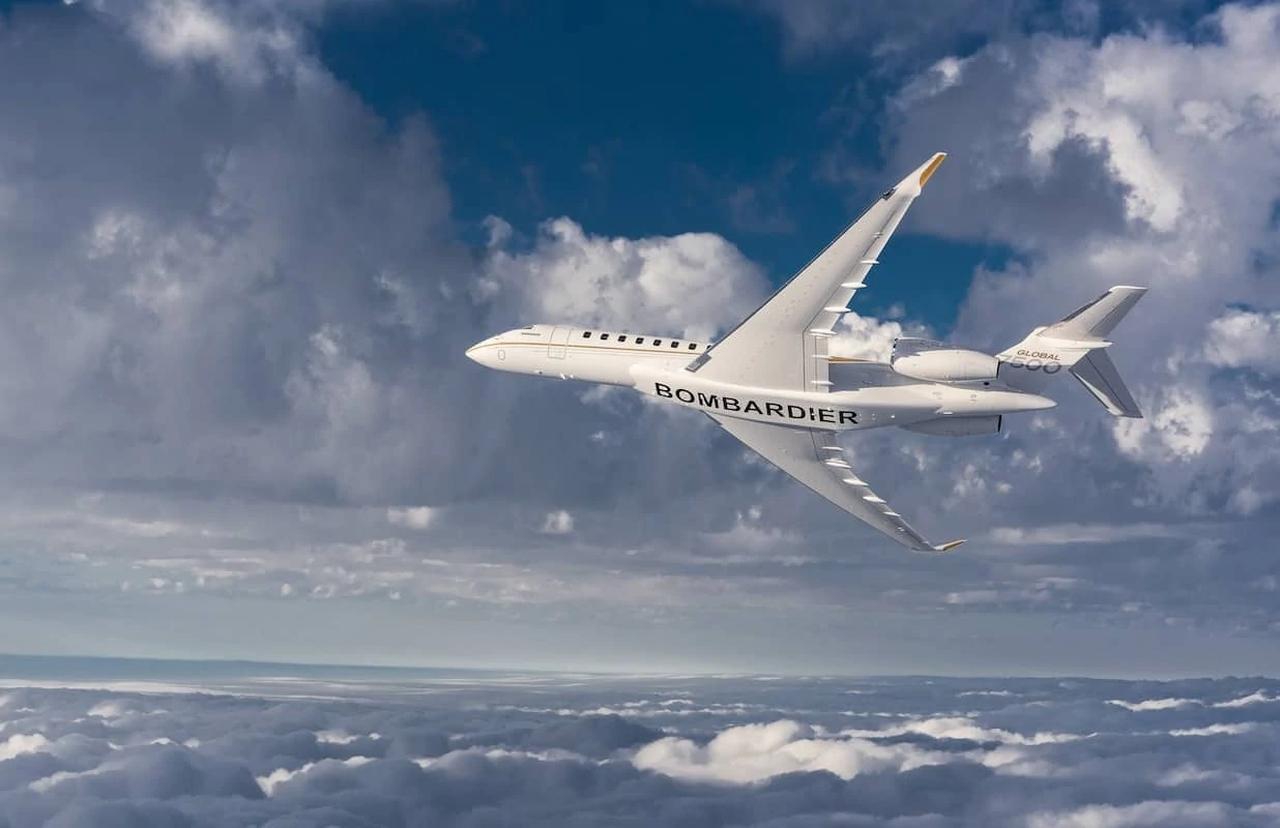
And then, at the top of the scale, we have the Bombardier Global 7500, an aircraft that can fly non-stop for 7,700 nautical miles. This theoretically allows the jet to make non-stop flights between Los Angeles and Singapore.
Thus, this results in a difference of over 5,000 nautical miles between the large jet with the longest range and the one with the shortest range.
Of course, there is a general grouping of large jets, most of which fall within the range of 3,500 to 4,500 nautical miles.
Variables Affecting the Range of a Private Aircraft
However, just like when looking at the average fuel consumption of private jets, these figures should be taken with caution. This is because there are numerous factors that will affect the maximum range of an aircraft. Unfortunately, all factors will lead to a decrease in the stated figures.
The following factors will negatively impact the range of the aircraft:
Speed and Altitude
Flying at higher speeds increases drag. Therefore, maintaining a higher speed requires more power. Consequently, manufacturers often set cruise speeds for longer distances to ensure the best balance between speed and range.
The higher you climb, the less dense the air becomes. However, climbing higher requires more thrust to reach the optimal altitude. Increased thrust leads to higher fuel consumption. Increased fuel consumption results in reduced range.
Passengers and Baggage
Passengers and baggage contribute to increased weight. Increased weight leads to increased drag. Increased frontal drag results in higher thrust requirements. The more thrust required, the more fuel is consumed. The more fuel consumed, the shorter the aircraft's range.
A roughly 10% increase in aircraft weight requires a 10% increase in thrust. This then leads to a 5% reduction in range.
Weather
Wind can be both a blessing and a curse. Cruising with a tailwind will optimize range. However, flying into a headwind requires more thrust. As a result, range will be significantly reduced.
Of course, wind conditions are difficult to predict when booking your flight. Therefore, when planning a flight on a private jet, it is essential to account for a margin of safety.
Summary
Given the vast number of private jet models available, it is more than likely that there is an aircraft that suits your needs.
Just because an aircraft is larger does not necessarily mean it will have a greater range than a smaller aircraft. However, the overall figures show that the larger the aircraft, the greater the range.
JETVIP: Beyond the Flight
Join 12,500+ subscribers and stay ahead of the curve.
Scan toopen Telegram