


 Rent a business jet
 Rent a plane
 Group charters
 Medical Aviation
 Empty Legs
 News
News
 Articles
 Company fleet
 Fleet
Fleet
 Cities and airports


Official Methodology of the “JETVIP Reliability Index”
Nov 29, 2025
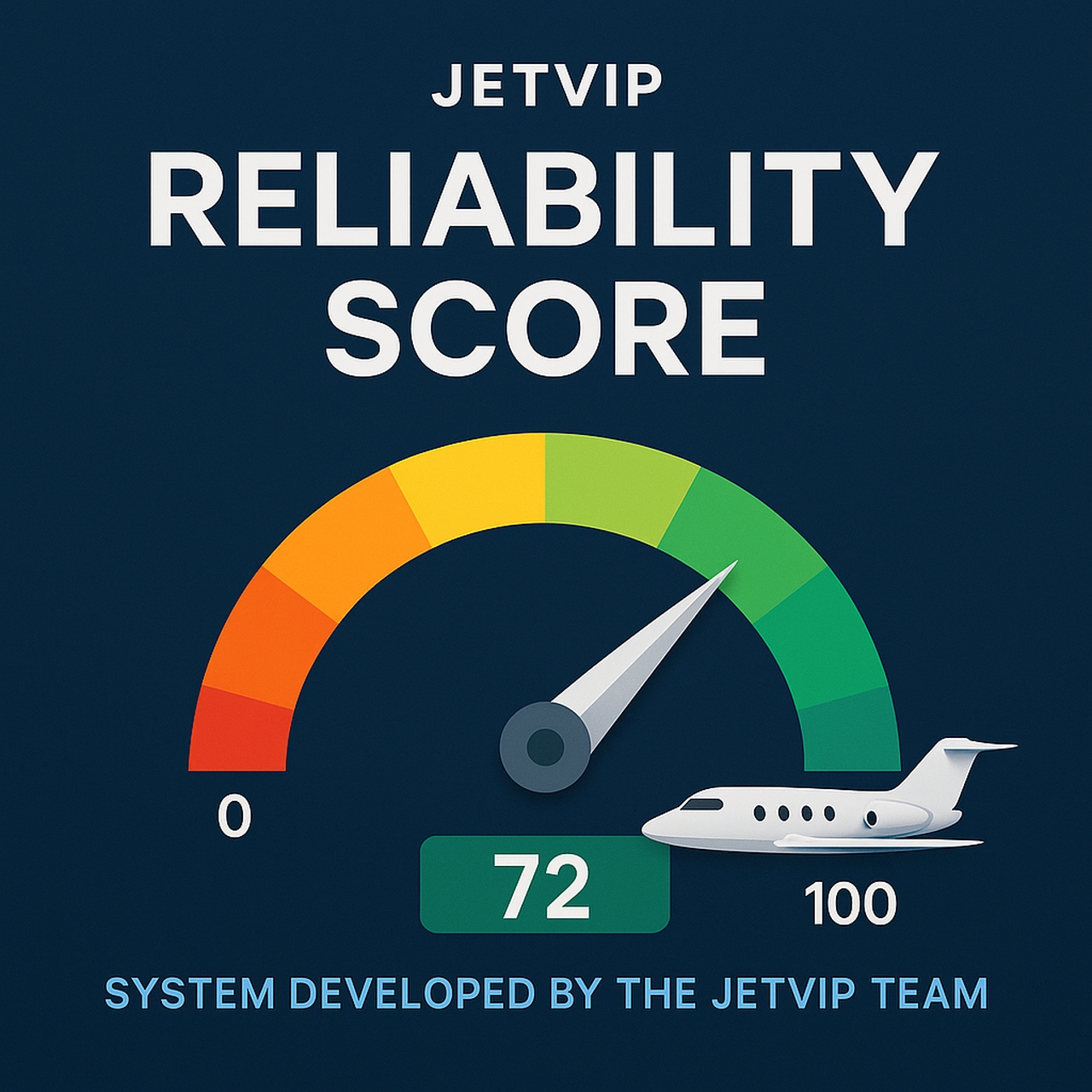
What is the JETVIP Reliability Index?
JETVIP Reliability Index is a proprietary system developed by the JETVIP team to evaluate the operational reliability of private aircraft.
The Index helps clients quickly understand how stable, predictable, and dependable a specific aircraft model performs in real-world operations.
This is not a “safety rating.”
All certified aircraft meet strict safety standards.
This is a rating of operational reliability, a crucial factor in business aviation:
-
frequency of AOG events,
-
incident and failure rates,
-
platform maturity,
-
engineering quality,
-
durability of avionics and engines.
All aircraft in our catalog will soon receive their individual JETVIP Reliability Index score.
This becomes the second unique rating system introduced by JETVIP:
-
the model popularity score,
-
the model reliability score.
Together, they allow our clients and partners to evaluate aircraft based on the perfect combination of price / reliability / popularity.
⭐ How the JETVIP Reliability Index is Calculated
Each aircraft model receives an individual score from 55 to 99, calculated using 24 parameters grouped into six core categories:
1. Platform Reliability (30%)
Based on the reputation and maturity of the aircraft family:
-
stability of engineering solutions
-
accumulated fleet experience
-
manufacturer’s engineering quality
-
known weak points of the model line
Example: Dassault Falcon and Pilatus platforms are traditionally among the most stable.
2. Operational Record & Failure Resistance (20%)
We analyze:
-
MTBF (Mean Time Between Failures)
-
average AOG downtime
-
total fleet flight hours
-
available operational reports
This category reflects how often the aircraft is prone to unplanned ground time.
3. Platform Age & Generation (15%)
Newer generations typically score higher:
-
NG / Gen2 / neo / E2 / NGX versions
-
modern avionics (G5000/G6000, ProLine Fusion, Honeywell Primus)
-
updated engines (PW600, Williams FJ44, GE Passport)
Older versions receive a downward correction.
4. Manufacturer Reputation (15%)
A comprehensive assessment of the brand:
-
consistency of engineering
-
build quality
-
avionics durability
-
long-term operational statistics
Example: Dassault, Gulfstream, Embraer and Pilatus are historically industry leaders.
5. Aircraft Class & Mission Profile (10%)
Different classes naturally have different reliability profiles:
-
long-range jets → highest reliability
-
light jets → medium
-
turboprops → very stable
-
regional aircraft → slightly lower
-
older Soviet/Russian platforms → below average
6. Model-Specific Parameters (10%)
Adjustments based on:
-
specific series (e.g., Learjet 24 vs Learjet 75)
-
engine version
-
known operational quirks
-
aggregated operator feedback
🎯 The Goal of the Rating
To help clients:
-
choose an aircraft that will not let them down,
-
minimize the risk of delays and rescheduling,
-
understand the real operational performance of each model.
🔥 Why the Rating Is Unique
Because it is based on:
-
real operator statistics
-
engineering and maintenance data
-
thousands of accumulated flight hours per platform
-
JETVIP’s own extensive internal database (aircraft, operators, routes)
No similar rating exists anywhere in the CIS region.
📌 Score Interpretation
-
95–99 → Benchmark reliability
-
90–94 → Very high
-
85–89 → Above average
-
80–84 → Stable and good
-
75–79 → Average
-
70–74 → Below average but acceptable
-
65–69 → Low
-
55–64 → Weak (older/rare platforms)
🛩️ Universal “Model Reliability” Text Block
(for dynamic insertion inside each aircraft page)
Model Reliability
The {{Model Name}} has a reliability rating of {{Rating}} / 100 according to the JETVIP Reliability Index.
This score reflects the aircraft’s operational stability, fleet maturity, manufacturer reputation, avionics generation, and known characteristics of the model.
What this rating means:
-
If Rating ≥ 90:
This aircraft belongs to the most reliable category in business aviation. The likelihood of unscheduled downtime is minimal. -
If 85–89:
A highly stable model with solid engineering and predictable performance. -
If 80–84:
A reliable and well-balanced aircraft suitable for regular charter operations. -
If 75–79:
A moderate reliability level. Suitable when balancing cost and mission profile. -
If 70–74:
A working platform that may be older or simpler. Occasional AOG events are possible. -
If <70:
A less reliable platform by modern standards. We recommend checking the condition of the specific aircraft before booking.
What influences the score:
-
structural and engineering stability
-
aircraft age and avionics generation
-
engine reliability
-
manufacturer reputation
-
operational failure statistics
This rating helps clients choose an aircraft that will provide a comfortable, predictable, and disruption-free flight experience.
🚀 Stay Tuned
We are actively developing new features and soon will present a fully redesigned JETVIP website built on a new platform and modern architecture.
We never stand still — JETVIP grows and improves every day.
With respect,
The JETVIP Team